For Finale users
From Finale to Maestro
In 2024 MakeMusic stopped developing and selling Finale. Maestro was made for the people who used it: it opens your .musx and .mus files, takes them back to Finale as .musx when needed, has the same Main Tool Palette and the same shortcuts, and it is free.
In three steps
Bring your scores into Maestro.
- 1
Download Maestro
For Mac (macOS 13 Ventura or later) or Windows 10 and 11. Free, with no limitations and no account.
- 2
Open the Finale file
With File → Open…, or drag it onto the window. You don’t need Finale installed: Maestro reads the file on its own, both .musx and the older .mus.
- 3
Check and save
If something couldn’t be imported, Maestro tells you right away. Then save the score as a Maestro document (.maestro).
Older .mus files, from Finale 2000 to 2012, open too: notes, dynamics, articulations, slurs, repeats, layout and lyrics come across. Chord symbols from .mus files don’t yet: for those, open the file in Finale if you have it and save it as .musx.
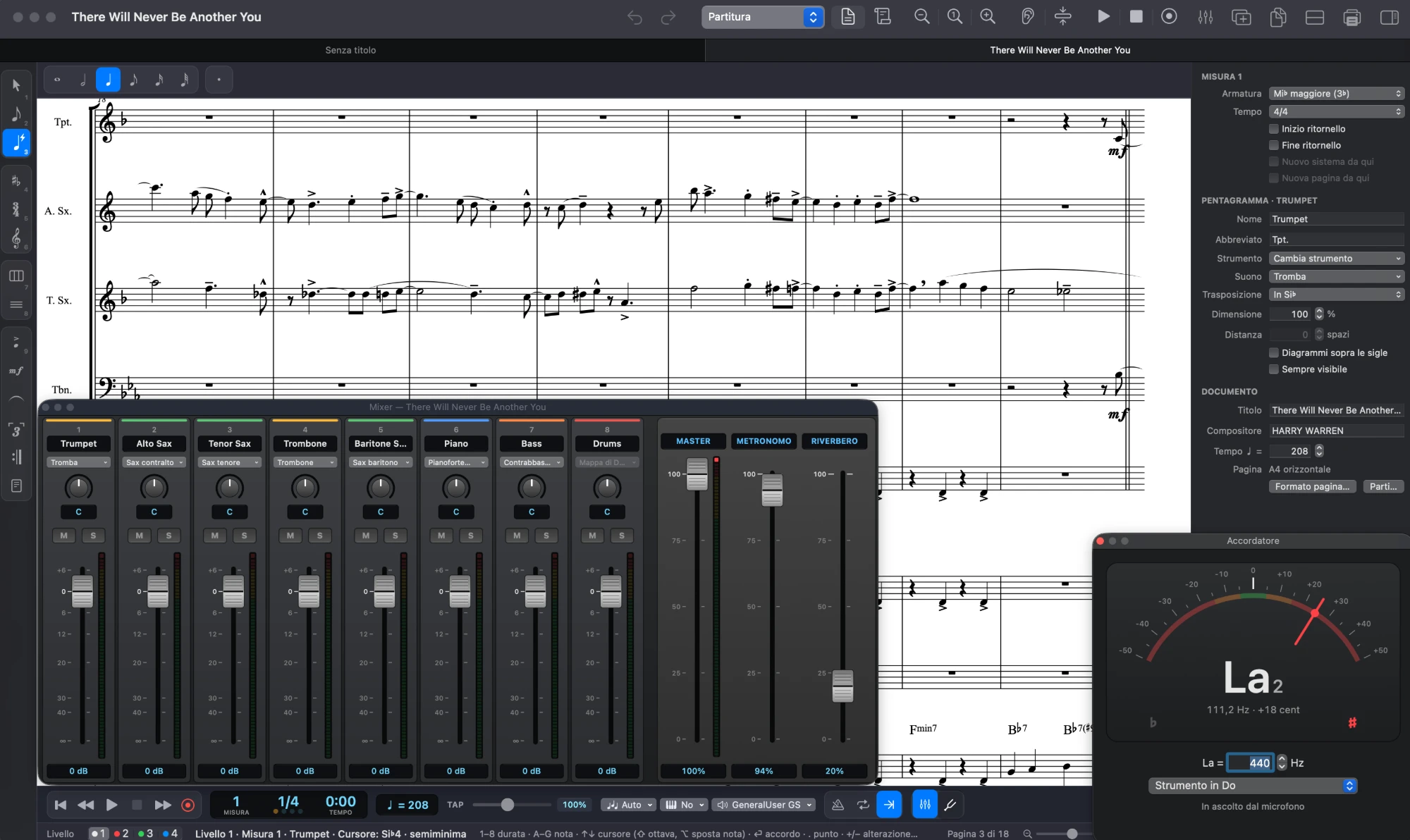
Your habits still work
The tools you know, where you expect them.
Maestro builds on Finale’s concepts, often with the same keys. On Windows ⌘ becomes Ctrl and ⌥ becomes Alt.
Finale and Maestro compared
What’s there, and what isn’t yet.
The Finale features people use most, and where Maestro stands. What’s missing, we say plainly.
| In Finale | In Maestro |
|---|---|
| Entry | |
| Simple Entry and Speedy Entry | YesWith the same keys as Finale, the Simple Entry cursor and the rests palette. |
| Measures completed with rests | YesWhen you leave a measure half full, as in Finale; Document → Check Incomplete Measures… finds them all and completes them. |
| HyperScribe | YesRecord from a MIDI keyboard, even with both hands, with the quantization you choose. |
| Four layers | Yes⌥⌘1…⌥⌘4, as in Finale. |
| Voice 2 within a layer | YesWith the apostrophe in Speedy Entry, as in Finale; from Finale files voice 2 comes across in a free layer of the measure. |
| Tuplets, grace notes, cross-staff chords | YesNested tuplets too. |
| Markings and text | |
| Articulations and expressions | YesFrom the palettes, as in Finale, plus any SMuFL symbol. |
| Smart Shapes | YesSlurs, hairpins, octave lines and glissandos. |
| Chord symbols and guitar diagrams | YesAnd Maestro can work out chord symbols from the notes. |
| Lyrics | YesWith several verses and hyphens. |
| Figured bass | YesEnter it with Notation → Figured Bass…; from Finale files the figures written in Finale Numerics or Eisenach come across, as do those from MusicXML and MuseScore. |
| Staves and page | |
| Tablature, percussion, slash and rhythmic notation | YesGuitar, bass and ukulele; percussion maps as in Finale. |
| Resize | YesSmaller or larger staves and systems, from 40 to 200%. |
| Linked parts | YesWith multimeasure rests, automatic cue notes and a layout for each part. |
| Finale’s fonts | YesMaestro, Jazz, Broadway, Engraver, Ash and Legacy are included. |
| Images in the score | YesWith Insert Image…. |
| Page text | YesWith Insert Page Text…: directions above a system, section titles and headers with page number and title. |
| Playback | |
| Playback and mixer | YesGeneral MIDI sound bank, mixer, metronome and swing. |
| Virtual instruments | YesAudio Unit plug-ins on Mac and VST3 on Windows. |
| Human Playback | YesPlayback styles (Standard, Baroque, Classical, Romantic, Jazz) with beat accents, phrasing and small human variations; dynamics, hairpins, articulations, swing, sustain pedal, pizzicato and mute. |
| Files | |
| Open .musx and .mus | YesWithout Finale installed, including .mus files from Finale 2000–2012. |
| Take a score back to Finale | YesFile → Export Finale (.musx)…: notes, lyrics, articulations, dynamics, chord symbols, repeats, tempo and sounds, with Maestro’s layout. Finale recreates the parts. |
| Export MusicXML, MIDI, PDF and audio | YesAnd PNG and SVG images too. |
| Plug-ins and scripts | Not yetThere’s no equivalent of FinaleScript, TGTools or Lua plug-ins. |
From the Finale file
What comes across, and what to check.
Maestro reads .musx files from Finale 26 and later, and those saved as .musx with Finale 2012–25, as well as older .mus files. In our test files, systems and pages come out the same as in Finale almost every time.
Comes into the score
- Notes, rests, chords and all four layers
- Ties and slurs, tuplets, grace notes
- Instruments with names, transposition and clefs
- Key and time signatures, clef changes
- Articulations, dynamics, hairpins, glissandos and octave lines
- Expression texts, tempo marks and rehearsal letters
- Chord symbols, including those set in the Broadway font
- Lyrics, with hyphens
- Repeats with their style (wings, back-to-back repeats), endings, segno, coda, D.C., D.S. and Fine
- Pickup measures, also in the middle of the score
- Page text: directions, section titles and headers with page number and title
- Percussion map, slash and rhythmic notation, measure repeats
- Braces and brackets, system and page layout, page size and margins
- Music font and text fonts: Finale’s six fonts (Maestro, Jazz, Broadway, Engraver, Ash and Legacy) come with Maestro
Worth checking
- Notes in “voice 2” come across in a free layer of the measure; only when all four layers are taken does Maestro tell you how many found no room.
- Figured bass comes across when written in Finale Numerics or Eisenach; with other fonts only single figures come across, and the message says how many are missing.
- Changes made only in the parts: the score version is used, and Maestro rebuilds the parts itself.
- Lines other than slurs, hairpins, glissandos and octave lines, and non-standard repeat texts.
- Six-line tablature comes in as five-line staves.
- If you prefer Maestro’s layout to Finale’s: Document → Layout → “Return to Maestro’s Layout”.
Frequently asked questions
Before you switch.
I only have the PDF of the score: can I open it?
Yes, if the PDF was exported from a notation program (MuseScore, Finale, Sibelius, Dorico, LilyPond, Maestro…): open it with File → Open… and you get the notes, lyrics, chord symbols and dynamics, with the original PDF alongside on the Mac. For scans there is File → Import Scanned Score….
Do I need Finale installed?
No. Maestro reads .musx and .mus files on its own, even on a computer that has never had Finale, and it comes with Finale’s fonts, so the score opens looking the way it did.
Is Maestro really free?
Yes, with no limitations, no subscription and no account. It updates itself when a new version comes out.
Can I save as .musx?
Yes: File → Export Finale (.musx)… saves the score, or the part you’re viewing, as a Finale document, with Maestro’s layout. Maestro’s working format is still its own (.maestro); for MuseScore, Dorico or Sibelius, use File → Export MusicXML….
Does it work on Windows?
Yes. Finale import is the same on Mac and Windows, and a score saved on one opens on the other.
What about my MusicXML and MIDI files?
They open too, including compressed MusicXML (.mxl). Maestro also exports to PDF, MIDI, audio (M4A or WAV) and PNG or SVG images.
Open your first Finale score.
Download Maestro, open a .musx or .mus file and pick up where you left off.